What a Street Name Can Tell You, and What It Cannot
Check a street name’s documented origin, distinguish an official naming reason from later explanations, and describe uncertain evidence without overstating it.
What does a street name actually tell you about the place you are standing in? Street-name origins can point to a person, a nearby feature, an older word or an official decision, but the label alone cannot tell you which explanation is right.
The useful distinction is between a name’s recorded use and the reason it was chosen. A dated map can establish that a label was in use by then; a naming minute may explain the decision. Those are different kinds of evidence, and confusing them is how an appealing story acquires the appearance of a fact.
Street-name origins depend on records of the naming decision
When several explanations circulate, begin with the exact claim. “The lane was named for a mill” proposes a reason for the name. “A mill once stood nearby” proposes a feature at a location. One statement does not establish the other.
Look for the earliest record that uses the street name, then ask whether it also explains the choice. Depending on the place, useful sources might include council minutes, approved street-naming lists, property deeds, local directories and dated maps. A directory usually records a label; minutes may preserve the decision behind it.
Say you hear that Birch Row was named for a vanished timber yard. Imagine a fictional council minute says a landowner requested “Birch Row”, while a later map prints that name. The minute supports the documented request and the map confirms subsequent use; neither connects the name to timber, so that part of the story remains unestablished.
A descriptive name is not proof of a site
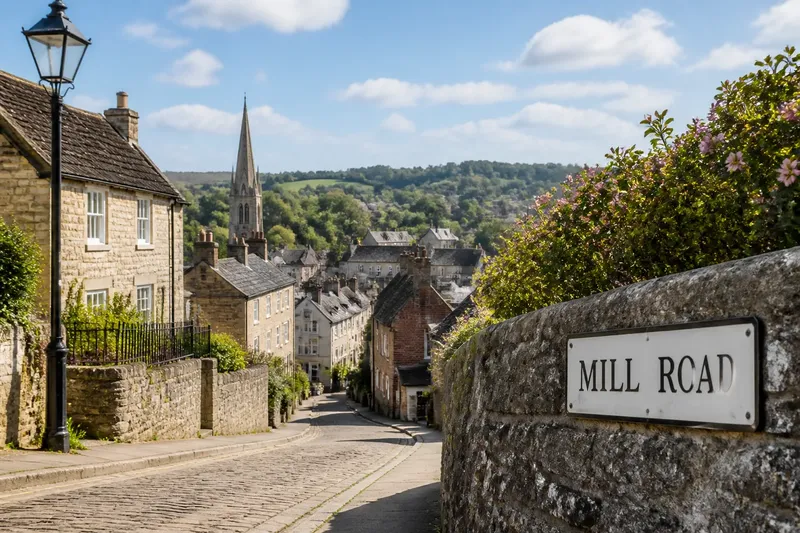
Mill Road, Chapel Lane and Orchard Street sound like records of local land use. Sometimes they preserve a nearby feature, but a name might also reflect an owner’s preference, a planned development or a label carried over from elsewhere.
To check a proposed location, compare the street with old property plans, land records, directories and maps that mark buildings or named features. A source placing a mill near the road supports that connection more directly than a matching word on a sign. If the records establish only proximity, describe the mill as nearby rather than saying the road marks its site.
What is not worth the effort is searching every occurrence of a name before checking whether the sources point to the same underlying account. Repetition can make a claim familiar; it does not give it a new origin.
Changed spellings and former names need their own trail
Older records may spell a street differently, abbreviate its name or show a label that was later replaced. Searching only the modern form can hide useful records or make one street appear to be several.
Search for spelling variants, word order and documented former names. A renaming record can connect an earlier label to the present one, but it may not explain where either name came from. Likewise, a name resembling a person’s surname is a lead to investigate, not evidence that the street commemorates that person.
Keep the search manageable with a short note for each source: its wording, its date and whether it records use, a naming decision or a later explanation. This is more useful than building a long list of references that all repeat the same unsupported claim.
How should you assess a street-name origin?
Does an old map prove where a street name came from?
An old map can show that a name was in use by the date it was made and may place the street beside other features. Unless it records the naming decision or gives a reason, it cannot establish the name’s origin.
Can a street named after someone identify that person?
Not by itself: several people may share a name, and a later account may choose one without documentary support. Look for a naming record or another source that explicitly connects the person with the street.
What if local sources give different origins?
Compare the sources they cite, not how confidently they tell the story. If one gives a contemporary record and another reports a local tradition, explain that difference; if neither has a traceable basis, leave the origin unresolved.
How can you describe an uncertain origin?
State what is documented, such as the earliest recorded spelling or a formal renaming, then identify the proposed explanation as uncertain. “Possibly named for” should not quietly become “named for” through repetition.
Street-name origins answer a narrower question than local history
A naming record may establish who proposed a label, when it entered use and what reason was given. A map may show its form and position at a particular date. Neither source, on its own, establishes every detail about the name’s namesake or the feature it appears to describe.
For street-name origins, the strongest account connects a specific claim to a record that can support it. When the record confirms only the name’s use, say that; when its reason is missing, leave the gap visible. A precise limit is more informative than a tidy explanation with no source behind it.