The Landmark Myth: A Tall Building Is Not Always a Useful Guide
Choose a useful landmark by how clearly it stands out and relates to your route, so you can distinguish broad orientation from a reliable local cue.
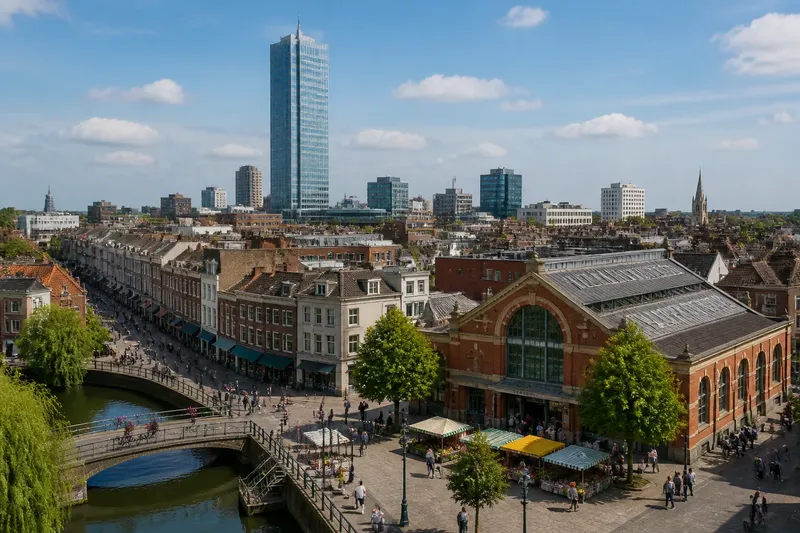
Is a tall building a useful landmark for finding your way? Sometimes: it can help you keep a broad sense of direction, but height alone does not tell you which street, entrance or public space you need. A clear landmark is distinctive and tied to a place you can identify on the ground.
Height gives a broad sense of direction
A tower visible above the roofs can help you keep your bearings in an open area or recognise a district from a distance. It is most useful when its silhouette is distinct from the surrounding skyline.
At street level, however, the same building may be hidden behind other blocks or resemble several nearby towers. It can orient you without identifying the particular square, entrance or stretch of street you are looking for.
If a neighbourhood has a cluster of similar glass buildings, their height offers little help distinguishing one from another. A smaller feature with a clear shape or setting may be easier to recognise.
Distinctive details make a landmark recognisable
Look for a feature with a form, colour or setting that is easy to tell apart: a red-brick library beside a square, a clock face above a market hall, or a bridge crossing a canal. A landmark need not be famous. It needs to be recognisable in the place where you expect to see it.
Its relationship to public space can make that recognition more useful. A market hall at the end of a pedestrian street, for instance, gives you a clearer sense of where the street leads than an isolated building visible somewhere beyond the rooftops.
Some details are less dependable than they look. Decorative lighting may be switched off, trees can obscure a sign, and temporary building work can cover a familiar façade. A landmark with more than one recognisable feature is easier to identify if one detail is obscured.
Different landmarks serve different purposes
A skyline feature helps with broad orientation
A tower or hilltop structure can help you understand your position in relation to a large area. Treat it as a general reference, not an exact pointer to a particular doorway or street.
A public feature identifies a place
A library, market hall or station entrance can help you name and recognise a particular point in the neighbourhood. Its public setting may make it easier to distinguish from buildings with similar outlines.
A sequence of local features describes a route
On a winding walk, a succession of recognisable places can make the route easier to follow: a square, a railway arch, then a canal entrance. Each feature marks a part of the neighbourhood rather than asking one distant building to explain everything.
Imagine you are heading to a community hall behind a row of shops. You can see a tall hotel beyond the shops, and the hall has a side entrance facing a small square. Treat the hotel as a broad orientation point, identify the row of shops as a local feature, then confirm the hall by its position beside the square. The result is a distinction between the general area and the actual destination, rather than mistaking visibility for proximity.
Match the landmark to what you need to know
A landmark can help you recognise an area, identify a public place or understand how one feature relates to another. Decide which kind of information you need before choosing what to pay attention to.
- If a tower has a distinctive outline and is visible above the neighbourhood, use it as a broad orientation point; if several buildings look similar, choose a more recognisable local feature instead.
- If a library or market hall has a clear public-facing entrance, use it to identify that place; if its entrances are difficult to distinguish, look for a recognisable feature in the surrounding square.
- If a bridge is easy to tell apart from nearby crossings, use it to identify the canal crossing; if several bridges look alike, use the adjacent towpath entrance or another distinctive feature instead.
- If a row of unusual shopfronts is visible as a group, use it to recognise that stretch of street; if shops have changed or the view is blocked, identify a more stable feature such as a square or public building.
- If one feature disappears behind buildings, use the next recognisable place in the neighbourhood; if the next feature is also unclear, consult a street map to identify a named public place before continuing.
- If a map shows a landmark but not its public entrance, use the map to identify the building and check its position against the surrounding streets; if that still leaves the entrance unclear, seek an on-site sign or ask locally.
It is not worth choosing a landmark just because it dominates a photograph or has a grand name. Fame and height can attract attention without helping you identify where you are.
How do you judge whether a landmark is useful?
What makes a landmark easy to recognise?
Look for a distinctive outline, colour or position among nearby buildings and public spaces. A feature that has several recognisable details is less easily confused with a similar-looking neighbour.
Can a distant building help you find a local place?
It can help you recognise the broad area, particularly if it stands out from the skyline. For a specific place within that area, identify a feature that is closer to the square, street or public building you mean.
What should you do if the landmark is obscured?
Use another recognisable feature in the neighbourhood, such as a named square, a bridge or a public building. If the remaining cues do not make the place clear, check a street map or look for local signage rather than guessing.
Is a famous building always a good landmark?
No. A modest library or distinctive row of shops may be easier to identify in its surroundings than a famous building with a similar-looking neighbour or an unclear public setting.
Use height for orientation and local features for recognition
A tall, distinctive building can help you recognise the broad shape of a neighbourhood. Local features such as a square, market hall or canal crossing can make a particular place easier to identify within it.
The useful landmark is not necessarily the tallest or best known. Choose the feature that stands out in its surroundings and tells you something precise about the place you are trying to recognise.